
Marketing Analytics
Marketing Attribution Explained: Models, Myths, and What’s Actually Possible
Attribution in the marketing world has become this overly-complicated beast that teams can’t or won’t implement due to time constraints, data cleanliness, or simply not understanding the topic.
It’s not perfect, it’s not a crystal ball, and it doesn’t replace strategy — but when done well, attribution gives you clarity, confidence, and better decision-making.
Why Attribution Feels Confusing
There are a few reasons attribution has a reputation problem:
- Different teams use the same words to mean different things. “Influence,” “credit,” “touchpoints,” “incrementality” — ask three people and you’ll get four definitions.
- Every platform reports attribution differently. Google Ads, Meta, HubSpot, GA4, Salesforce, Marketo — they all use their own models and lookback windows.
- There are dozens of models, but only a handful most teams actually need. The rest is mostly academic unless you have very mature and clean data.
So attribution ends up feeling like a dark art where stakeholders feel the juice isn’t worth the squeeze instead of what it really is: structured common sense.
What Attribution Actually Is
Attribution exists to answer one core question:
“What marketing activities influenced this conversion or deal?”
That’s it.
Attribution is a way of distributing credit across the touchpoints that collectively led to someone converting — clicking an ad, booking a demo, starting a trial, or becoming a customer.
It’s not meant to be a perfect truth. It’s meant to be a consistent lens for evaluating your marketing.
The Three Layers of Attribution
It helps to think about attribution in layers instead of one big monolith.
Layer 1: Rule-Based Attribution
These are the simple, fast models most platforms ship with:
-
First-touch: 100% of the credit goes to the first interaction.

-
Last-touch: 100% of the credit goes to the last interaction before conversion.
-
Linear: Every touchpoint gets equal credit.
-
Time decay: More recent touches get more credit than older ones.
-
U-shape (position-based): First and last touches get most of the credit; the middle shares the rest.
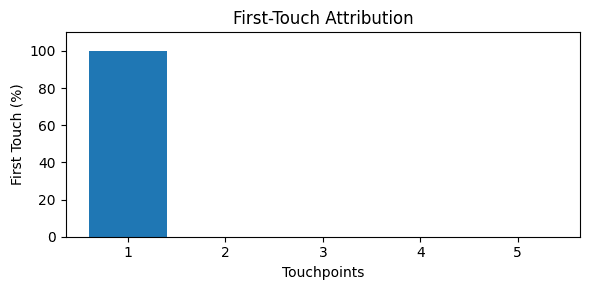
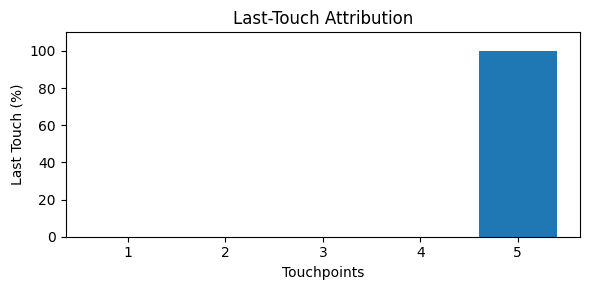
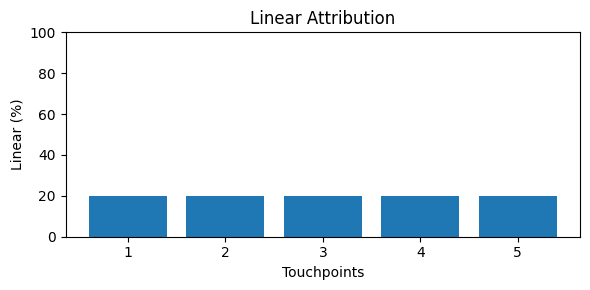
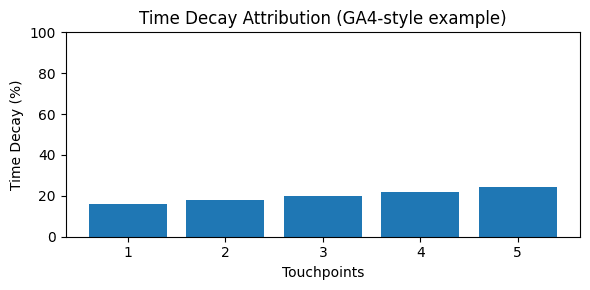
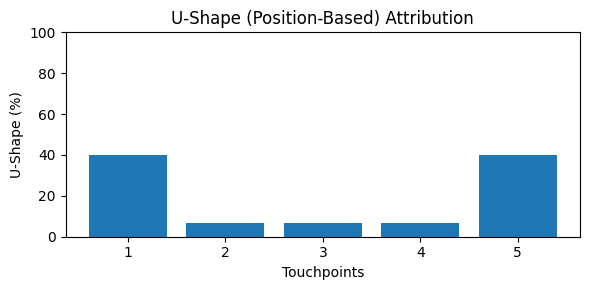
These are great for directional insight and quick comparisons, especially when you’re still cleaning up your data.
Layer 2: Data-Driven Attribution
Now we get into more advanced territory: models that learn from your actual customer journeys.
Markov chain models (removal effect)
Think about a basketball team. What happens if one player is removed from the roster? Does the team perform better? Worse? Markov attribution works the same way: Remove a channel → see how conversion probability drops → assign credit accordingly.
Shapley value–inspired models
Shapley value looks at every possible combination of touchpoints and measures how much better (or worse) the outcome would be with or without each specific channel.
Regression-based attribution
You make small changes to inputs (spend, frequency) and measure how the output (revenue) changes to determine which variables actually move the metric.
Layer 3: Incrementality
This is the “gold standard” where you run experiments (geo tests, holdouts, lift studies) to measure whether a channel actually causes lifts in conversions or revenue.
Simple Models You Should Know
| Model | Best Used For | How to Think About It |
|---|---|---|
| First-touch | Understanding which channels spark initial demand | Who started the conversation? |
| Last-touch | Identifying closers and conversion-driving channels | Who closed the deal? |
| Linear | Evenly crediting all touches in longer journeys | Everyone helped along the way. |
| Time Decay | Journeys where recency matters or decisions evolve over time | Who influenced the decision closest to the finish line? |
| U-Shape | Balancing top-of-funnel and bottom-of-funnel impact | Who kicked things off and who finished them? |
Advanced Models You Should Know
| Model | Best Used For | How to Think About It |
|---|---|---|
| Markov | Understanding how each channel changes conversion probability | How does the team perform when a key player is taken off the ice? |
| Shapley Value | Fairly distributing credit across all channel combinations | Which player consistently makes the biggest impact across all lineups? |
| Regression | Finding which channels actually move revenue or conversions | Which ingredients truly change the taste when you adjust the recipe? |
The Biggest Reason Attribution Breaks: Data Quality
Almost every “attribution problem” I see is really a data quality problem in disguise.
- UTMs are inconsistent or missing.
- Lifecycle stages aren’t populated reliably in the CRM.
- Revenue isn’t tied to opportunities or deals.
- Users can’t be stitched across web, CRM, and product.
Before You Build a Model, Focus on These Five Things
- Consistent UTMs: A documented, enforced naming convention.
- CRM lifecycle stages: Clear definitions for Lead, MQL, SQL, Opportunity.
- Reliable conversion tracking: Form fills, demo requests, sign-ups — all tracked cleanly.
- Revenue in the CRM: Deal values attached to Closed Won opportunities.
- User stitching: A way to connect web activity back to contacts.
If you’d like a quick, honest read on where you stand, try our free diagnostic.
Have questions about attribution?
We help companies of all sizes build clean, trustworthy multi-touch attribution — without overcomplicating it.